

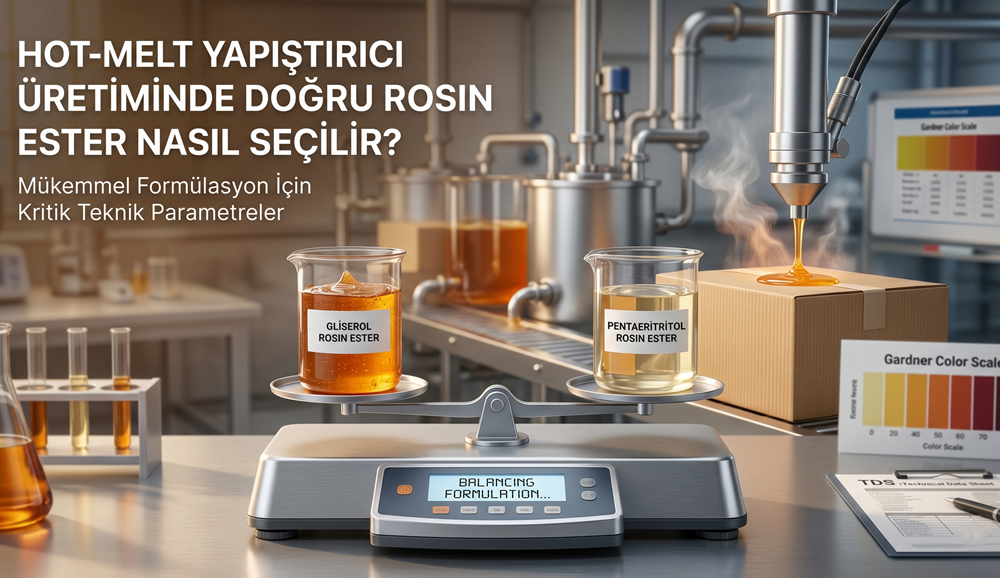
In the hot-melt adhesive (HMA) industry, achieving the perfect formulation is a delicate balancing act. Relying solely on base polymers (such as EVA, SIS, SBS, or Metallocene) is rarely enough to deliver the high tensile strength, specific adhesion, and flexibility demanded by industrial applications. This is where tackifier resins come into play as the functional heart of the formulation.
As a bio-based and eco-friendly solution, Rosin Esters are among the most preferred tackifier groups in hot-melt production. However, if you are experiencing costly downtime on your production line due to charring in the melting tank, heavy odor emissions, phase separation, or weak initial tack, you might be using the wrong rosin ester derivative for your formulation.
In this comprehensive guide, we will explore the critical technical parameters you must evaluate when selecting the optimal rosin ester for your HMA formulations, along with strategic insights to ensure long-term cost efficiency and premium performance.
What is Rosin Ester and Its Role in Hot-Melt Formulations
Rosin Ester is a modified resin produced by esterifying natural gum rosin—harvested from pine trees—with polyols such as glycerol or pentaerythritol at elevated temperatures. While unmodified gum rosin is highly acidic and thermally unstable, this chemical modification transforms it into a highly stable, durable, and industrially viable raw material.
In hot-melt adhesive systems, rosin esters fulfill several fundamental functions:
-
Specific Adhesion: They significantly enhance the base polymer's ability to bond with challenging, low-surface-energy substrates (e.g., coated cardboard, wood, plastics).
-
Wetting Ability: They allow the molten adhesive to spread flawlessly over the substrate, penetrating micro-cavities for a deep mechanical grip.
-
Open Time Optimization: They allow formulators to precisely adjust how long the adhesive remains tacky and workable before solidifying.
-
Viscosity Modulation: They optimize the flow properties of the molten adhesive, ensuring smooth and consistent application through machine nozzles without stringing.
Critical Technical Parameters for Selecting the Right Rosin Ester
To choose the perfect raw material for your specific formulation and end-product application, it is essential to correctly interpret the four primary criteria found on a Technical Data Sheet (TDS).
1. Softening Point and Heat Resistance
The softening point indicates the temperature at which the resin begins to flow (measured via the Ring and Ball method). Rosin esters typically feature softening points ranging between 85°C and 105°C.
-
High-Temperature Applications: For end-products exposed to elevated thermal stress, such as bookbinding or automotive interiors, esters with higher softening points (100°C and above) should be selected. This directly improves the SAFT (Shear Adhesion Failure Temperature) of the final adhesive.
-
Standard Packaging Applications: For case and carton sealing that requires rapid set times and standard bonding, a softening point range of 85°C - 90°C delivers optimal performance.
2. Polymer Compatibility (EVA, SIS, SBS, and Metallocene)
A major advantage of rosin esters is their exceptionally broad compatibility profile. Because they contain both aliphatic and aromatic structures, they achieve excellent molecular compatibility with traditional EVA (Ethylene Vinyl Acetate) based systems. Furthermore, they blend homogeneously with styrenic block copolymers like SIS and SBS without phase separation. For next-generation Metallocene polyolefin-based systems, highly stable rosin esters serve as a crucial component to balance the formulation's polarity.
3. Color (Gardner Scale) and Optical Clarity
The final color of the adhesive is a decisive factor, particularly in the hygiene sector (diapers, feminine care), transparent labeling, and premium packaging. Resin color is measured using the Gardner Scale; the lower the number, the lighter and clearer the resin.
-
If your goal is to produce water-white or highly transparent adhesives, you should opt for highly refined, light-colored rosin esters with a Gardner value of 3 or below.
4. Acid Value and Oxidation Stability
The acid value reflects the efficiency of the esterification reaction and is highly critical for equipment health. Rosin esters with a low acid value (typically <15 mg KOH/g) prevent corrosion inside application tanks, hoses, and fine nozzles. Additionally, a low acid value ensures that the resin remains highly resistant to oxidation during extended exposure to high temperatures, thereby preventing unwanted viscosity fluctuations during its pot life.
Glycerol Ester vs. Pentaerythritol Ester: Which Should You Choose?
Rosin esters are broadly classified into two categories based on the polyol used during manufacturing. Choosing between the two depends entirely on your targeted performance metrics and budget:
| Technical Feature | Glycerol Rosin Ester | Pentaerythritol Rosin Ester |
| Molecular Structure | Lower molecular weight | Cross-linked, higher molecular weight |
| Softening Point | Typically 85°C - 90°C | Typically 95°C - 105°C+ |
| Thermal Stability | Good (Sufficient for standard use) | Excellent (Superior heat resistance) |
| Cohesive Strength | Moderate to High | Very High (Boosts internal strength) |
| Typical Applications | Case/carton sealing, labels, standard PSAs | Bookbinding, woodworking, heavy-duty packaging |
| Cost-to-Performance | Highly Economical | Premium Performance Investment |
Common Resin-Related Troubleshooting in HMA Production
-
Charring and Gelation in the Tank: If the molten adhesive forms a dark crust or black char deposits after extended periods in the melting tank, the thermal stability of your resin is insufficient. The solution is to upgrade to pentaerythritol-based esters fortified with premium antioxidants.
-
Heavy Odors and VOC Emissions: Strong, irritating odors on the production floor are often caused by volatile organic compounds (VOCs) present in unrefined resins. Switching to deodorized, steam-distilled premium rosin esters drastically improves the working environment for operators.
-
Brittleness in Cold Environments: If HMA-sealed boxes pop open in cold storage, the glass transition temperature (Tg) of the formulated resin is likely poorly matched to the environment. Formulations can be adjusted using specific glycerol ester derivatives to impart greater low-temperature flexibility.